
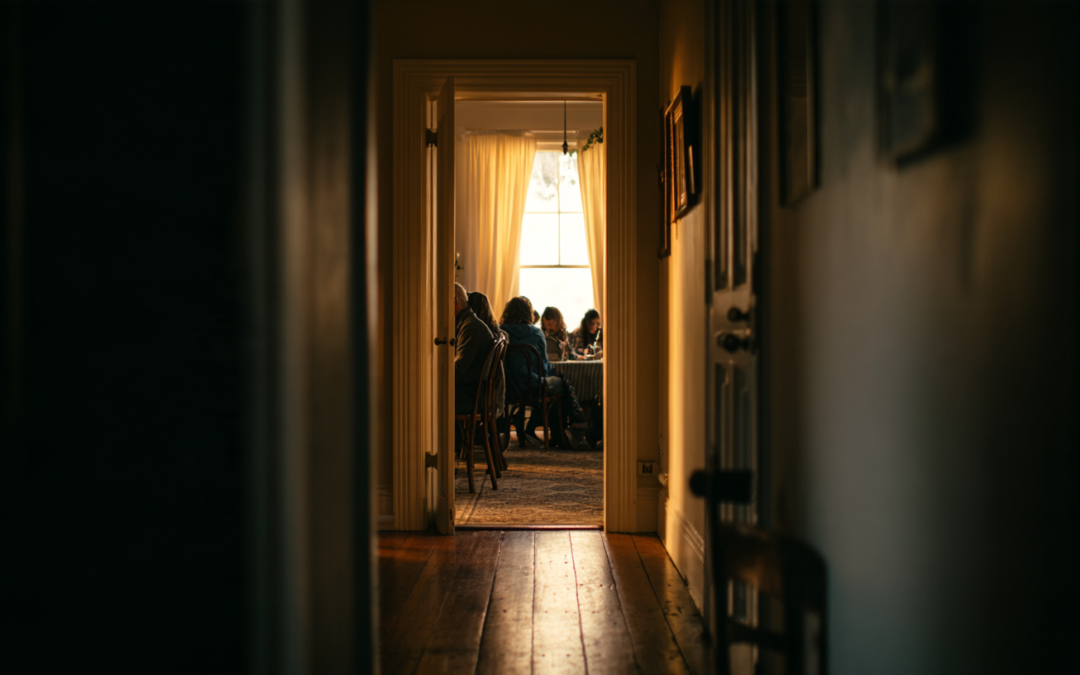
Every November, the same question formatted different ways begins to show up in my office. Sometimes it’s stated as a plan: I’m not going this year. Sometimes it is expressed as dread that feels stuck between two bad choices. It’s the question of what to do when the idea of going home for the holidays invokes a degree of anxiety and trepidation, you’re not sure you want to put yourself through.
We’re living through a cultural moment on this. Estrangement from parents has gone from something people hid to something people write essays about. The language of ‘boundaries’, of ‘protecting your peace’, of ‘going no-contact’, is everywhere.
For the people who have already left
Let me start where I should. If you’ve cut off a parent or a sibling, I’m not here to offer you advice or a lecture. My inclination is instead to offer a hug, because I’m sure you’ve been through some difficult experiences.
There are many situations where distance is not just defensible but necessary. If there was sexual abuse in your past that has never been named. If there was overt, obvious harm and the adults who knew about it chose not to protect you. If contact today still involves active cruelty or real danger. None of what follows is written to talk you out of protecting yourself from that. You don’t need my permission, and you don’t need to justify it to anyone at a dinner party.
The line that’s harder to see
But there’s a wide territory between abuse and ease, and most families live there. Most families are made of people who are selfish sometimes and defensive often and loving in imperfect ways we don’t always recognize. A certain percentage of the human population is simply difficult to deal with. Some of those people are related to us, and it was never going to be otherwise.
The question I find myself asking with clients is not whether the family is dysfunctional. Every family is. The question is whether what’s happening to you in that house is harm, or whether it’s the ordinary friction of being near people who are not like you and never will be.
This matters because of what family is. From an attachment perspective, these are the people whose faces taught your nervous system what safety and threat feel like. From a family systems perspective, you don’t really leave a system by exiting it; the roles and patterns come with you, into your marriage and into how you raise your own kids. And from everything we know about resilience, the people who weather life best are rarely the ones with the fewest difficult relationships. They’re the ones who have learned to stay connected to imperfect people without being destroyed by them.
Connection can survive a lot. It can survive political differences. It can survive the fact that your mother has never once asked how you’re really doing. It can survive your father’s silence about the things that happened when you were growing up. Not always, and not without cost. But I think it can and does more often than the current conversation suggests.
A question to ask about your boundaries
Here’s something I’d invite us all to sit with before you decide anything this season. Look at the boundary you’re holding and ask what it’s for.
Some boundaries exist to protect peace. You limit the visit to two nights because three breaks you. You leave the room when the conversation turns to something you can’t bear. You stop sharing the parts of your life that you know will be misunderstood.
Other boundaries are punitive. They exist, if we’re honest, to make someone else feel what we felt. The silence is meant to be noticed, and the absence is a message we’re imagining them experiencing.
Look, the desire to have your pain registered by the person who caused it is completely understandable. But my point is that punitive boundary isn’t really a departure from a dysfunctional family system. It’s a way of staying in it. You’re still in the fight; you’re just using different tools. And it keeps us tethered to the one thing you were trying to get free of: a dysfunctional family.
The apology that isn’t coming
Which brings me to the hardest part, and the part I believe matters most.
Many people are owed something by our parents that they are never going to receive. An acknowledgment, or an apology, or a moment where they look at them and say, ‘I see what I did, and I’m sorry’.
But for many people, that will never arrive. Our parents are usually not monsters. They are limited in exactly the ways that hurt us in the first place. The father who couldn’t be tender when you were six is many in fact be the same man at seventy-five. Demanding for him to finally become someone before you engage with him may cost you a lot.
If we insist that we cannot be at peace with another person until they have acknowledged our specific wounds, we may find ourselves very lonely. The wounds were real. The trouble is that we made our peace conditional on something that was never in our hands.
There’s an existential honesty in accepting this. Life has limits, and one of them is that other people will not always become who we needed them to be. Accepting that can look like resignation from the outside, but it’s what makes any real peace possible, because it’s the only kind that doesn’t depend on someone else’s cooperation.
So here is what I find myself hoping for people, in whatever way they can manage it.
That you can set your father free from everything he couldn’t be for you.
That you can set your mother free from everything she couldn’t be for you. T
That you can look at them, with their politics, and their silence about the things you both know happened, and see them as they are, rather than as the people who still owe you.
None of that obligates you to go home, and it has nothing to do with pretending. Some people will do this work of acceptance and setting their parents free and still decide the house over the holidays is not a place they can be. That’s a legitimate outcome.
One last thing
At the end of the day, this comes down to where each person is standing, in that moment, with what they know. No article, including this one, can make that call for you.
And if someone you love tells you they’re not going home this year, they don’t need a lecture. They don’t need to be talked out of it. What they probably need, in that moment, is a hug.
Matthew Bishop, EdD, LMFT, is the founder of Sonder Therapy Group in San Diego. He works with individuals, couples, and families, and uses Emotionally Focused Therapy to help people stay connected to the people who matter to them, including the difficult ones.